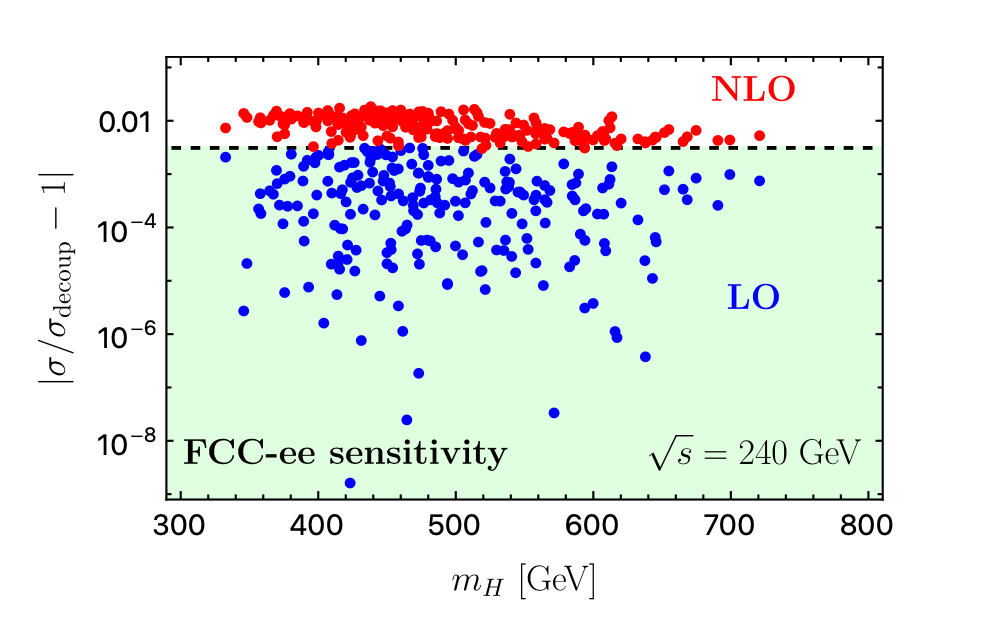
“Z and Higgs Factory Implications of Two Higgs Doublets with First-Order Phase Transitions” investigates the potential of future electron–positron colliders to probe a specific Higgs sector extension (the so-called two-Higgs-doublet model) that can support a strong first-order electroweak phase transition. This is a key ingredient for electroweak baryogenesis, which is a possible explanation of the observed overabundance of matter over antimatter. We identify parameter regions consistent with current experimental constraints that offer viable phase transition dynamics. We then investigate precision Higgs and electroweak measurements that can be accessed at electron-positron colliders and trace the model’s quantum properties in these environments. We find that new physics deviations are within the projected sensitivity of these future Higgs factories, turning these powerful tools into a means for indirectly testing the thermal history of the early Universe. Interestingly, such deviations can occur even when the predicted exotic particles are inaccessible at the Large Hadron Collider (LHC). This motivates precision measurements as a complementary strategy to direct searches at the LHC and other future facilities. (Read more)
 christophenglert.uk
You must be logged in to post a comment.