In this work, we develop and explore a new way to search for undiscovered particles at the Large Hadron Collider. Traditionally, one looks for “bumps” in data. These small and local excesses of events at a particular energy signal the presence of a new particle if the excess is statistically significant. However, in many well-motivated theories, new particles can interfere with known processes in such a way that they reduce the number of events instead. This creates a “dip” rather than a bump, making the new physics much harder to detect with standard methods.
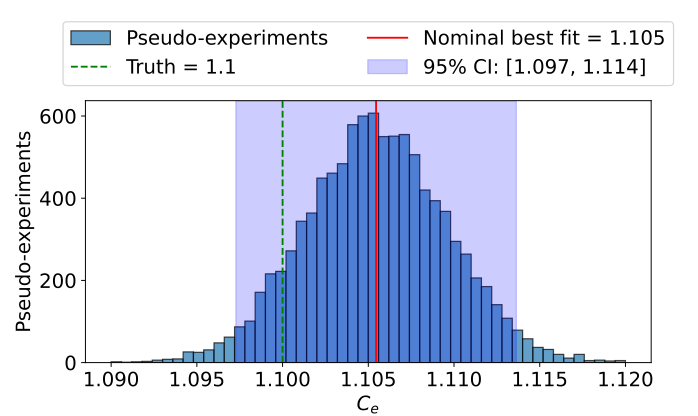
We develop a strategy called “dip-hunting” to address this challenge. Using modern machine learning techniques, we employ neural networks to recognise subtle patterns in data that arise from this interference. Rather than simply looking for excesses, the method asks: given an observed pattern, how likely is it to come from a new particle?
We demonstrate, in a simplified model, that this approach can successfully identify and even measure the properties of such hidden particles. The method is robust and flexible, suggesting it could complement existing search strategies and help uncover new physics that might otherwise remain invisible. (Read more)


You must be logged in to post a comment.