Physicists often use simplified models to describe possible new particles or forces, especially when experiments like the Large Hadron Collider have not yet revealed clear signs of new physics. One such framework is the “Higgs Effective Field Theory” (HEFT), which extends the Standard Model by allowing the Higgs boson to behave more flexibly than the Standard Model of Particle Physics predicts. But there’s a challenge: depending on how the theory is written, some mathematical terms can look different while still describing the same physics. This makes it tricky to estimate how accurate predictions really are.
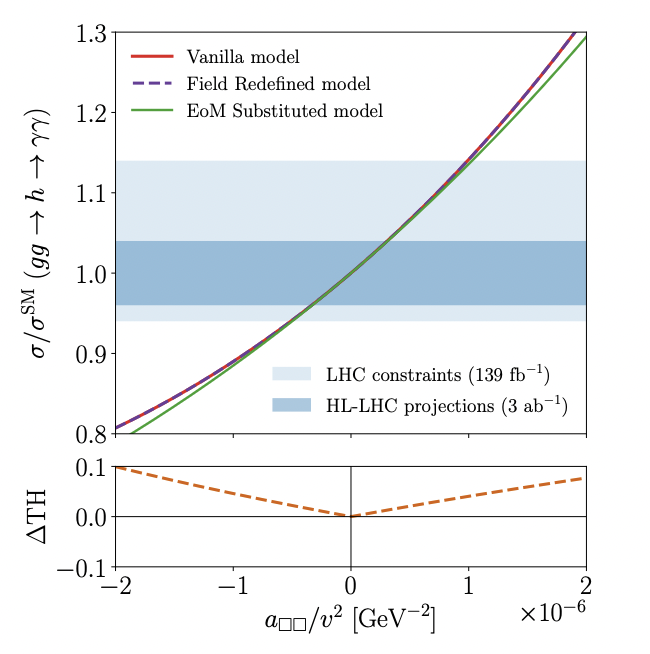
“Assessing (H)EFT theory errors by pitting EoM against Field Redefinitions” develops a systematic way to quantify those uncertainties by comparing different ways of simplifying the equations. Using a concrete example, we demonstrate how these choices impact predictions for Higgs boson processes, including rare events such as the simultaneous production of four top quarks. This approach helps ensure collider studies interpret Higgs data reliably. (Read more)
 christophenglert.uk
You must be logged in to post a comment.