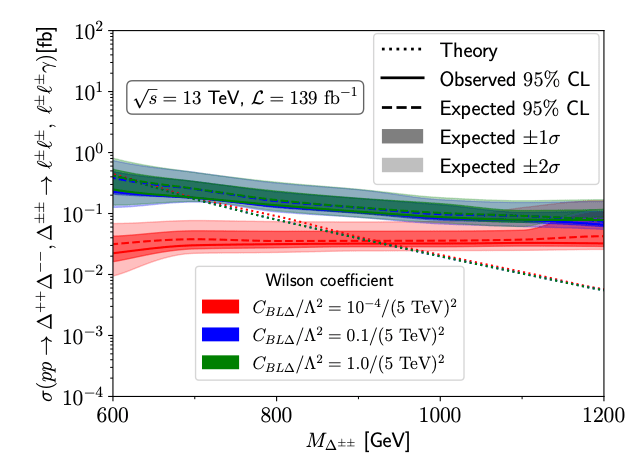
Neutrinos are a standard candles in the search for new physics beyond the Standard Model. This work revisits one of the ‘classic’ explanations for tiny neutrino masses: the so-called type-II seesaw model. In this framework, the Standard Model is extended by an additional Higgs-like field with non-SM quantum numbers. A striking prediction is a doubly charged Higgs boson, which can decay into two same-sign leptons. This is a very clean and unusual signal that experiments at the LHC have been actively searching for. Current searches assume the simplest version of the model. But what if the underlying theory is slightly more complicated? To address this, we use an effective field theory approach that captures possible additional interactions arising from more complete high-energy theories. These extra interactions can change how the doubly charged Higgs is produced and how it decays. Reinterpreting current ATLAS results, we show that mass limits can either become stronger or significantly weaker depending on these additional effects. Looking ahead, targeted strategies at the High-Luminosity LHC could probe masses above 2 TeV, ensuring that new physics does not escape detection through subtle deviations from standard expectations. (Read more)
 christophenglert.uk
You must be logged in to post a comment.