Our paper investigates a long-standing puzzle in particle physics: certain decays of B mesons occur at rates that significantly disagree with precise theoretical predictions. These decays are considered especially clean, meaning they should be well understood. Therefore, the discrepancy is surprising and could potentially point to new physics beyond the Standard Model.
One possible explanation is the existence of new particles that modify these decays. However, any such particles should also be visible at the Large Hadron Collider. The challenge is that collider searches have not found clear evidence for them, creating a tension between low-energy measurements (B decays) and high-energy experiments.
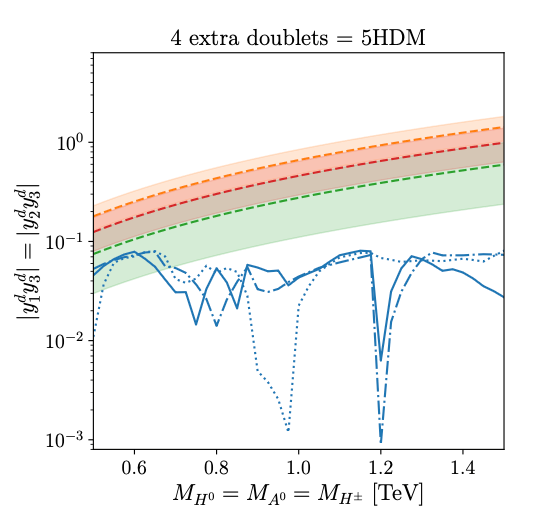
We explore three ways in which this tension might be resolved: the new particles might be hidden in difficult-to-detect collider signatures (such as top-quark final states), theoretical uncertainties in the decay calculations might be larger than expected, or there could be multiple new particles that dilute collider signals. We find that none of these explanations resolves the discrepancy easily. Even in extended models, collider constraints remain strong. Only rather contrived scenarios that combine several effects without theoretical necessity can partially reconcile the combined dataset. The conclusion is that this anomaly remains a genuine and unresolved puzzle, deserving further theoretical and experimental scrutiny. (Read more)


You must be logged in to post a comment.