This work investigates how the early Universe changed its state as it cooled down. Such phase transitions are important because they could help explain why the Universe contains more matter than antimatter, and they might also have produced gravitational waves that future experiments could observe.
Most existing calculations describe these transitions using perturbative methods – an expansion in a small parameter. These techniques are powerful, but they can miss important effects. One such effect is the Polyakov loop, a quantity that captures how gauge fields behave in thermal field theory. In Quantum Chromodynamics, the Polyakov loop is a measure of (de)confinement.
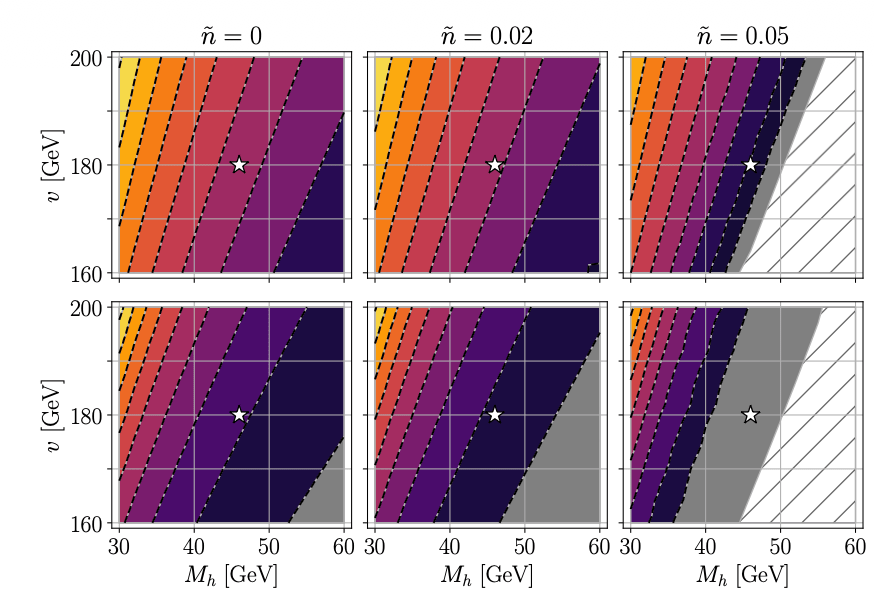
We show that including Polyakov-loop effects changes the thermal Higgs potential in a systematic way. In particular, they tend to soften phase transitions. Transitions that would look strongly first-order (and therefore relevant for matter abundance over antimatter) in the usual calculation can become weaker, or even turn into second-order transitions or smooth crossovers (bad news for matter generation!). They can also lead to the production of a much weaker gravitational-wave signal. Therefore, Polyakov-loop effects are not a small technical detail: they may substantially reduce the parameter space in which strong electroweak phase transitions are expected. (Read more)


You must be logged in to post a comment.