The Higgs boson discovered at the LHC looks remarkably similar to the particle predicted by the Standard Model of Particle Physics. But this does not mean that the Higgs sector itself has to be minimal. Additional Higgs bosons could exist and still remain difficult to observe directly. In this work, we investigate how the proposed FCC-ee electron–positron collider could uncover such new physics through extremely precise measurements of Higgs production together with a Z boson. We use the Two-Higgs-Doublet Model as a concrete example, where the familiar Higgs is accompanied by additional neutral and charged scalar particles.
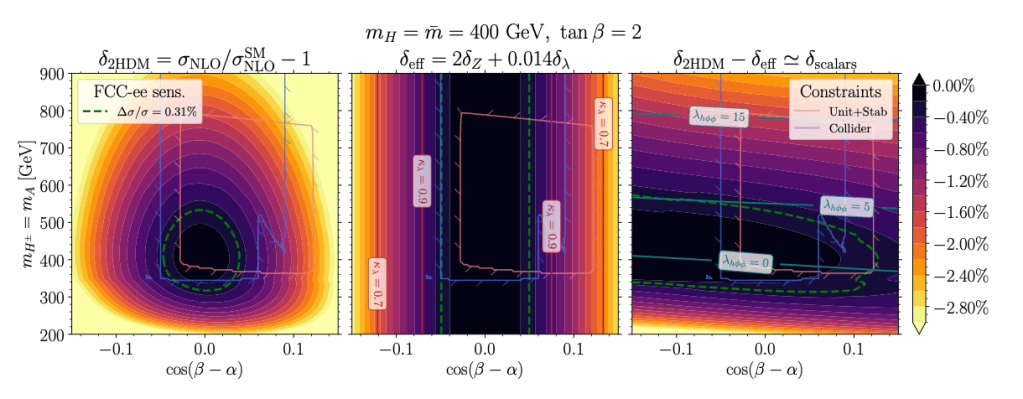
A particularly interesting result arises when the observed Higgs has exactly Standard-Model-like couplings at tree level. Even in this “alignment” limit, additional Higgs particles can leave measurable quantum-loop effects. For realistic scenarios, these can change the Higgs-production rate by around one percent or more, compared with an anticipated FCC-ee precision of about 0.3%. The extraordinary precision of FCC-ee will provide an indirect window onto an entire extended Higgs sector, even when the new particles themselves evade direct observation. (Read more)


You must be logged in to post a comment.