The answer is yes. The Higgs boson could provide a unique window onto a hidden sector of particles that otherwise have no Standard Model interactions. This work investigates whether future collider measurements could go beyond discovering such a Higgs portal and determine what kind of hidden particles lie behind it. We compare a simple portal with scalar particles to more complex interactions that include hidden fermions or vectors.
If the new particles are light enough for the Higgs to decay into them, invisible-Higgs measurements constrain the portal so strongly that distinguishing its microscopic origin becomes extremely difficult. The situation changes considerably when the hidden particles are heavier than half the Higgs mass. Then the portal can reveal itself through missing-energy production, precision Higgs measurements and modifications of the Higgs self-interaction.
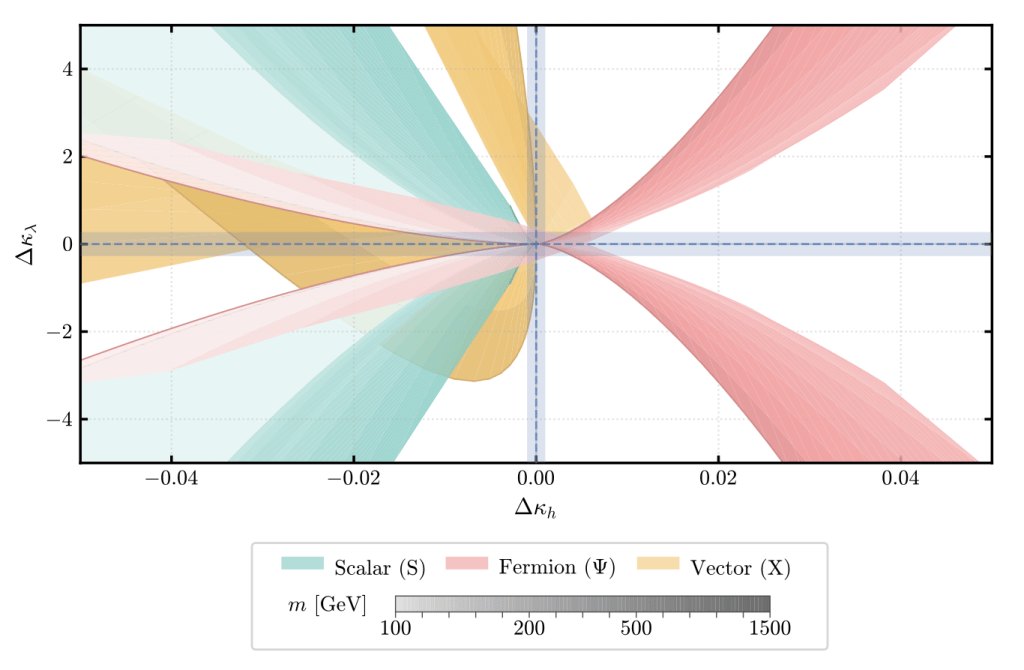
Crucially, no single measurement tells the whole story. Searches at the HL-LHC can provide discovery sensitivity, precision measurements at a planned electron-positron collider probe characteristic quantum effects, while a future hadron-hadron collider accesses the energy growth of higher-dimensional interactions and measures the Higgs self-coupling much more precisely. Together, these complementary measurements can largely distinguish scalar, fermionic and vector Higgs portals, although some degeneracies remain. (Read more)


You must be logged in to post a comment.